Korean Breast Augmentation: A Specialist’s Guide to Implant Selection and Placement Techniques

Korean breast augmentation is widely recognized for its precision, natural results, and advanced surgical techniques.
Among the leading specialists in this field is Dr. Seo Il Beom, the breast surgery expert and director of Marble Plastic Surgery in Seoul.
His approach focuses on individualized planning based on each patient’s anatomy, tissue characteristics, and aesthetic goals.
For anyone considering breast augmentation, one essential question always arises:
“Which implant should I choose, and where should it be placed for the most natural and long‑lasting result?”
Breast augmentation is not simply about inserting an implant.
It requires careful evaluation of implant type, incision location, placement plane, tissue thickness, nipple position, chest shape, and lifestyle factors.
In Korea, natural aesthetics and long‑term stability are highly valued, making the dual‑plane placement a commonly recommended technique.
This guide explains the major types of breast augmentation and the differences between implant placement methods, helping patients understand how Korean specialists achieve refined and natural outcomes.
🔷 1. Choosing the Right Implant Type
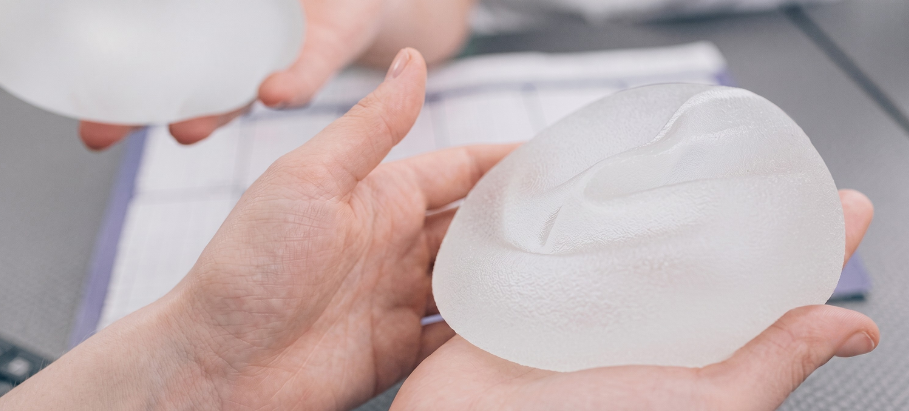
The first major decision in breast augmentation is selecting the implant.
In Korea, two main types are used, each offering distinct advantages.
✔ Silicone Implants
Silicone implants are the most widely used in Korea.
- Soft, natural feel
- Excellent shape retention
- Available in various shapes (round, anatomical)
- Wide range of sizes and profiles for personalized design
- Preferred by most international patients as well
Korean clinics offer extensive customization options, allowing surgeons to match implants precisely to each patient’s chest width, projection, and desired volume.
✔ Saline Implants
- Filled with sterile saline
- Safe absorption in case of rupture
- Slightly firmer feel compared to silicone
- More common in the United States than in Korea
Because Korean patients generally prefer a softer, more natural texture, silicone implants are overwhelmingly favored.
🔷 2. Incision Options — Where the Implant Is Inserted
The incision location affects scarring, recovery, and surgical visibility.
✔ Transaxillary Incision (Armpit)
The most popular method in Korea.
- No visible scar on the breast
- Performed with endoscopic assistance for precise dissection
- Faster recovery
- Highly preferred by international patients
Korea is known for its advanced endoscopic transaxillary technique, which allows surgeons to minimize bleeding and create accurate implant pockets.
✔ Inframammary Fold Incision
- Provides excellent surgical visibility
- Quick recovery
- Common in Western countries
- Scar hidden under the breast fold
✔ Periareolar Incision
- Scar blends with the areola border
- Useful for certain anatomical cases
- Not ideal for patients with small areolas
The incision method is chosen based on scar preference, anatomy, implant size, and the surgeon’s expertise.
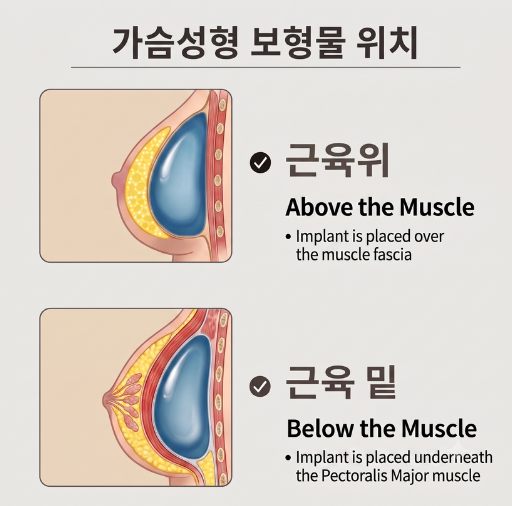
🔷 3. Implant Placement — The Most Critical Factor in Breast Augmentation
Implant placement determines the final shape, movement, and long‑term stability of the breast.
✔ Subglandular (Over the Muscle)
- Faster recovery
- Less postoperative pain
- No movement during exercise
- Not ideal for patients with thin tissue (implant edges may show)
✔ Submuscular (Under the Muscle)
- More natural upper‑breast contour
- Reduced implant visibility
- More discomfort and slower recovery
- Implant may move during chest muscle activation
✔ Dual Plane
The most commonly used technique in Korea.
- Upper portion of the implant is under the muscle
- Lower portion is under the breast tissue
- Combines the benefits of both planes
- Ideal for patients with thin tissue
- Creates a natural slope and stable lower‑breast volume
Dual‑plane placement is especially suitable for Asian body types, where tissue thickness is often limited.

🔷 4. Why Dual Plane Is Highly Preferred in Korea
✔ Natural Upper Breast Line
The muscle covers the upper implant, preventing visible edges.
✔ Enhanced Lower Breast Volume
The lower portion sits under breast tissue, creating a smooth, natural curve.
✔ Suitable for Thin Tissue
Reduces the risk of rippling or implant visibility.
✔ Long‑Term Stability
Muscle support helps maintain shape over time.
Dual‑plane placement offers balanced aesthetics and durability, making it a top choice among Korean specialists.
🔷 5. Types of Dual‑Plane Techniques
Dual‑plane placement is not a single method; it varies depending on the patient’s anatomy.
✔ Type I
Standard dual‑plane, suitable for most patients.
✔ Type II
Extended muscle release for patients with slightly low nipple position.
✔ Type III
Most extensive release, ideal for mild breast ptosis (sagging).
🔷 6. Who Is a Good Candidate for Dual‑Plane Placement?
- Thin breast tissue
- Lack of upper‑breast volume
- Desire for natural results
- Mild breast sagging
- Long‑term stability prioritized
🔷 7. Understanding the Limitations of Dual‑Plane
- More postoperative discomfort due to muscle dissection
- Possible implant movement during intense exercise
- Requires a highly experienced specialist for optimal results
Dual‑plane placement is highly effective, but surgical skill is crucial.
🔷 Finding the Right Method for Your Body
Breast augmentation is not simply about increasing size.
It is a structural redesign of the chest, requiring careful consideration of implant type, incision location, and placement technique.
At Marble Plastic Surgery, Dr. Seo Il Beom evaluates each patient’s anatomy, tissue thickness, nipple position, and lifestyle to recommend the most suitable method.
Korean breast augmentation is trusted for its natural results, advanced technology, and high safety standards.
Choosing the right technique with a qualified specialist is the key to achieving beautiful and long‑lasting results.
For more information, please visit https://marbleps.com/.