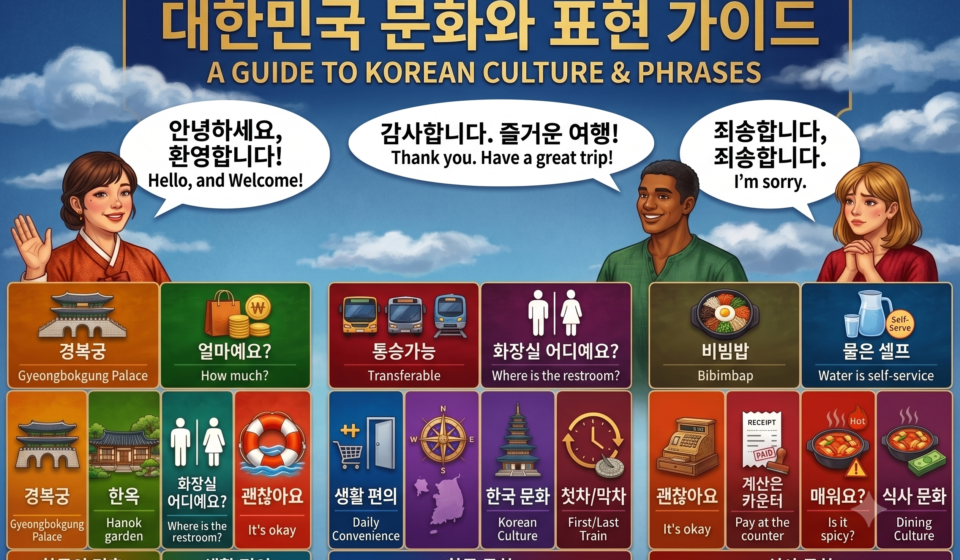

Because Korea is a largely single‑language society, knowing a few Korean expressions can make daily life much easier and safer for foreigners living or traveling here.
In everyday situations—restaurants, shopping, transportation, hospitals—a simple Korean phrase can dramatically improve communication. Many foreigners say language is the biggest challenge when they first arrive,
but learning just a handful of basic expressions can make your experience smoother and much more enjoyable.
This guide organizes 50 essential Korean expressions by real-life situations. These include greetings, restaurant orders, shopping, directions, transportation, hospital visits, and even plastic surgery clinics.
You’ll also learn why these expressions matter in Korean culture and how to use them naturally.
🟦 1. Basic Greetings & Courtesy Expressions
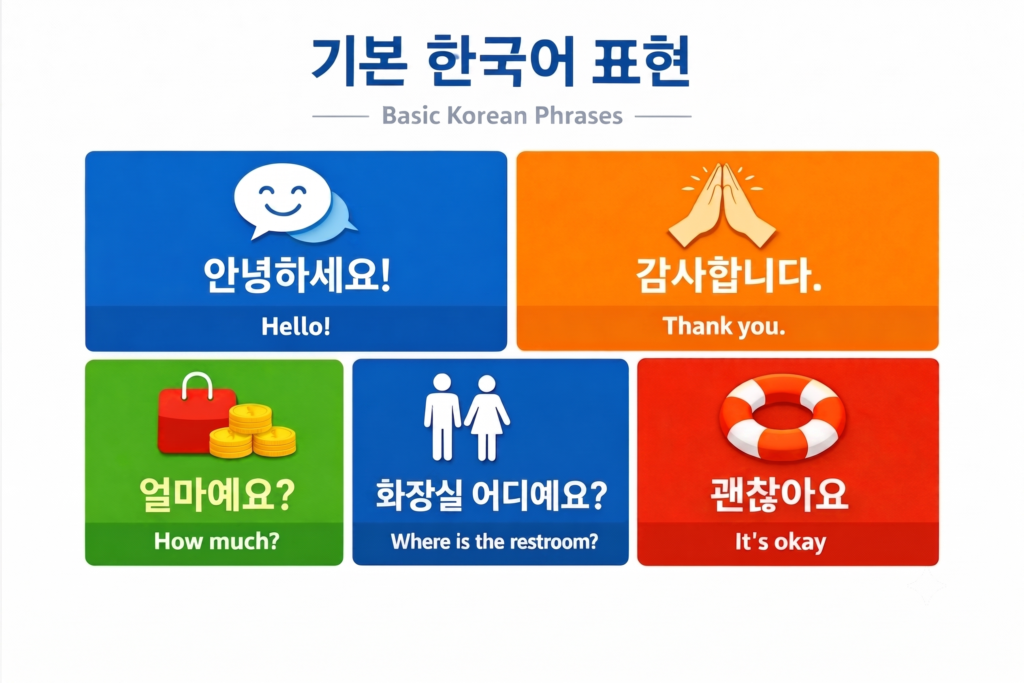
These are the expressions Koreans use most frequently. Because Koreans value polite communication, foreigners who use these phrases naturally leave a very positive impression.
- Hello — 안녕하세요
- Thank you / Thanks — 감사합니다 / 고맙습니다
- I’m sorry / Excuse me — 죄송합니다 / 실례합니다
- Yes / No — 네 / 아니요
- It’s okay — 괜찮아요
- I like it / That’s right — 좋아요 / 맞아요
- I don’t know — 몰라요
These phrases are used dozens of times a day.
Especially “안녕하세요” and “감사합니다” are the most important courtesy expressions in Korea.
🟦 2. Common Expressions in Restaurants & Cafés
Korea has a highly developed dining culture, so knowing how to order food or call staff is essential.
- Excuse me (to call staff) — 여기요 / 저기요
- Please give me this — 이거 주세요
- Please recommend something — 추천해 주세요
- Water, please — 물 좀 주세요
- Please make it less spicy — 덜 맵게 해주세요
- To-go, please — 포장해 주세요
- I’ll pay now — 계산할게요
- Card, please — 카드요
- Receipt, please — 영수증 주세요
In Korean restaurants, people call staff by saying “저기요” instead of “Excuse me.”
Foreigners who use this naturally often receive very friendly responses.
🟦 3. Shopping, Convenience Stores & Markets
Korean convenience stores and shopping malls are extremely convenient, but you’ll still need Korean expressions to find items or ask about prices.
- How much is it? — 얼마예요?
- Do you have this? — 이거 있어요?
- Do you have another color? — 다른 색 있어요?
- Do you have a smaller size? — 더 작은 사이즈 있어요?
- Can I get a refund? — 환불 가능해요?
- Can I exchange this? — 교환 가능해요?
- Bag, please — 봉투 주세요
In traditional markets, “얼마예요?” alone solves most situations.
🟦 4. Directions & Transportation
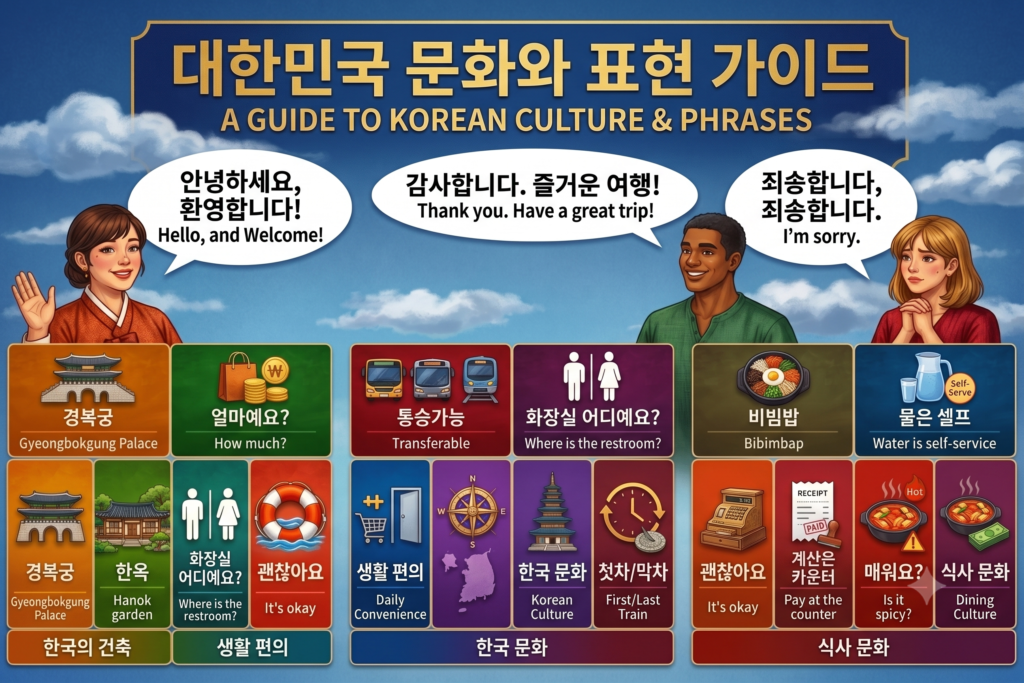
Korea’s subway and bus systems are world‑class, but they can feel complicated for first‑time visitors.
- Where is ___? — 어디예요?
- Where is the restroom? — 화장실 어디예요?
- Is this the right bus? — 이 버스 맞아요?
- I get off here — 여기서 내려요
- Please help me — 도와주세요
- Please call a taxi — 택시 불러주세요
Koreans are generally very helpful when asked for directions.
“도와주세요” is one of the most useful expressions for foreigners.
🟦 5. Hospitals & Plastic Surgery Clinics
Korea is globally known for its medical and plastic surgery services. These are common expressions foreigners use when visiting hospitals or clinics.
🔹 Basic Hospital Expressions
- I have an appointment — 예약했어요
- I want a consultation — 상담 받고 싶어요
- I have pain — 통증 있어요
- I have swelling — 붓기 있어요
- I have bruising — 멍이 있어요
- Please give me medicine — 약 주세요
🔹 Common Expressions in Plastic Surgery Clinics
- I want a natural look — 자연스럽게 하고 싶어요
- I want a more defined look — 더 또렷하게 하고 싶어요
- Can I see before‑and‑after photos? — 전후 사진 볼 수 있어요?
- How long is the recovery time? — 회복 기간 얼마나 걸려요?
- Are there any side effects? — 부작용 있어요?
- How is the anesthesia done? — 마취는 어떻게 해요?
- Please tell me the cost — 시술 비용 알려주세요
- Do you have English‑speaking staff? — 영어 가능한 직원 있어요?
Many Korean clinics have English-speaking coordinators because they serve many international clients.
🟦 6. Emergency Expressions
In emergencies, short and strong expressions are the most effective.
- Help me — 도와주세요
- I’m hurt — 아파요
- Call the police — 경찰 불러주세요
- I need to go to the hospital — 병원 가야 해요
These expressions can literally save lives.
🟦 Korean Learning Tips for Foreigners
Korean may seem difficult at first, but learning basic expressions makes daily life much easier.
- Koreans respond very positively when foreigners use Korean.
- Even imperfect pronunciation is usually understood.
- Memorizing just 20 basic expressions makes your day much easier.
- Restaurant, shopping, and transportation phrases are essential.
- Korean is not just a language tool—it’s a key to understanding Korean culture.
This guide summarizes 50 practical Korean expressions that foreigners use most often in real life.
Whether you’re starting life in Korea, preparing for a trip, or visiting Korean hospitals or plastic surgery clinics, these expressions will help you communicate more comfortably and naturally.
Learning them will make your daily life smoother and your interactions with Koreans much more enjoyable.